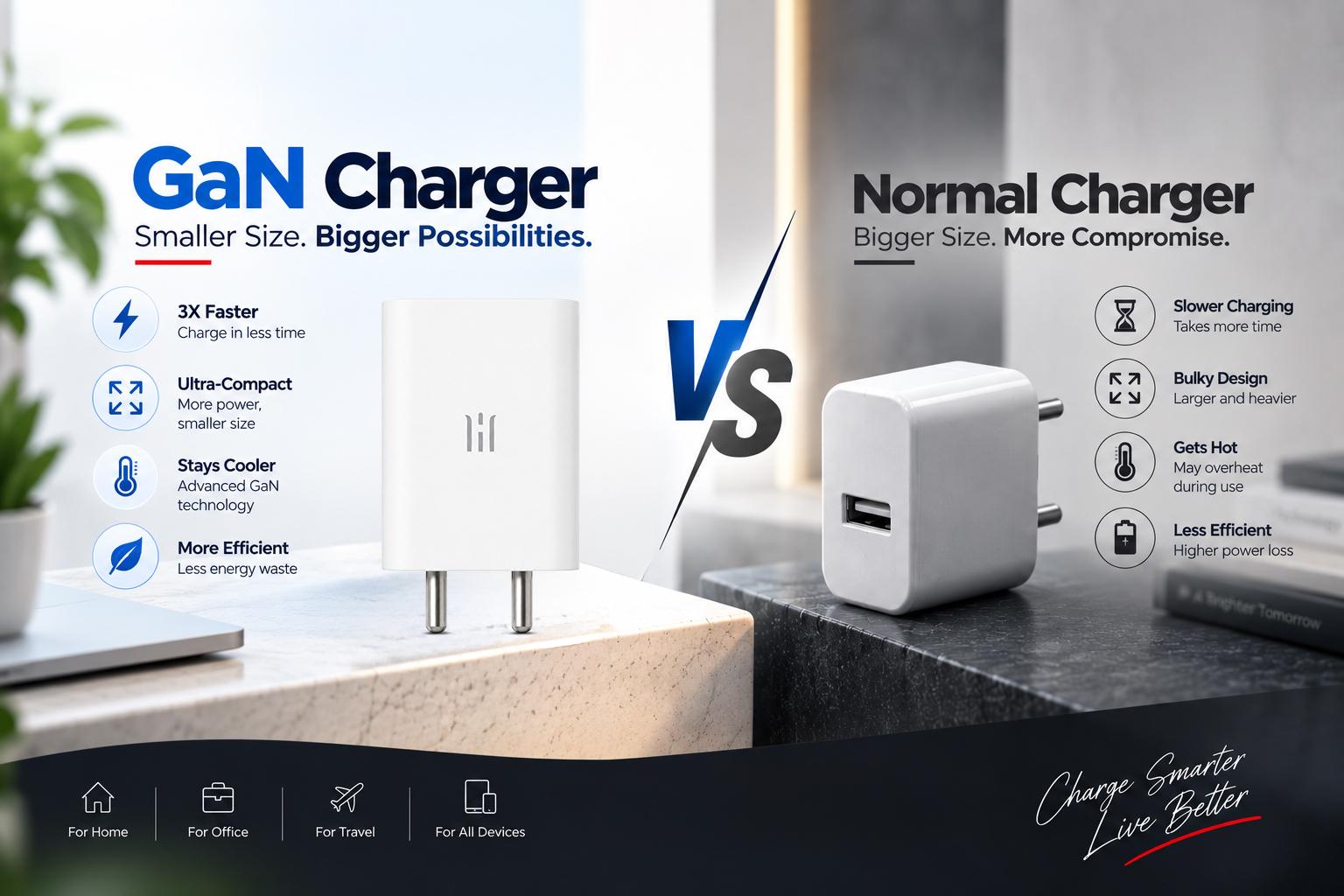
What Is a GaN Charger?
GaN stands for Gallium Nitride, a semiconductor material used in modern power electronics.
Compared with conventional silicon-based designs, GaN technology can operate efficiently at high switching frequencies and power levels. This helps reduce energy loss and heat, allowing chargers to be designed with a higher power density.
In simple terms:
GaN technology allows manufacturers to put more charging power into a smaller charger.
That is why a compact 65W or 66W GaN charger can provide considerably more power than older, bulky chargers while remaining convenient to carry.
What Is a Normal Charger?
A normal charger generally refers to a conventional charger using traditional power-conversion components, commonly based on silicon semiconductor technology.
Traditional chargers have been used successfully for years and are still suitable for many basic charging requirements. However, when higher power output is needed, conventional designs can become larger because additional space may be required for thermal management and other components.
This is one reason modern GaN chargers have become popular for high-power USB-C charging.
GaN Charger vs Normal Charger: Key Differences
| Feature | GaN Charger | Normal Charger |
|---|---|---|
| Technology | Gallium Nitride semiconductor | Traditional silicon-based design |
| Size | Compact | Usually larger at comparable higher power |
| Weight | Lightweight | Can be heavier |
| Heat management | Generally better efficiency and lower heat generation | Can generate more heat |
| Power density | High | Generally lower |
| Fast charging | Excellent when paired with standards such as USB-C PD | Depends on charger design |
| Laptop charging | Suitable for compatible USB-C laptops | Depends on power output |
| Travel | Very convenient | Can be bulkier |
| Price | Usually higher | Often more affordable |
| Best for | Modern, high-power devices | Basic everyday charging |
Actual charging performance depends on the charger's specifications, charging protocol, cable, and the device being charged.
1. Size and Portability
One of the biggest advantages of GaN technology is compact size.
Because GaN power components can operate efficiently at high frequencies, manufacturers can design smaller power-conversion systems. Less heat generation can also reduce the need for bulky thermal-management components.
GaN Charger
- Compact and lightweight
- Easy to carry in a pocket or laptop bag
- Ideal for travel
- Takes less space around a power outlet
Normal Charger
- Can be larger, particularly at higher wattages
- May take more space in a bag
- High-power conventional chargers can feel bulky
Winner: GaN Charger
2. Charging Speed
A common misconception is that GaN itself automatically makes a charger faster.
That's not quite correct.
Charging speed primarily depends on:
- Charger wattage
- USB-C Power Delivery (PD) support
- PPS or other charging protocols
- Your device's maximum supported input
- Cable capability
GaN technology helps make high-power charging more efficient and compact, while protocols such as USB-C PD handle power negotiation between compatible devices and chargers.
For example, a compatible 66W USB-C PD GaN charger can be an excellent option for devices that support higher-power USB-C charging.
Winner: GaN Charger for high-power modern devices
3. Heat Generation
Heat is one of the important considerations when designing and using power electronics.
GaN chargers are generally more efficient than conventional designs, meaning less energy is lost as heat during power conversion. This can contribute to cooler operation, particularly when delivering higher power.
However, no charger remains completely cool. Some warmth during charging is normal.
A quality charger should also include appropriate safety and thermal-management systems.
Winner: GaN Charger
4. Laptop Charging
This is where high-wattage GaN chargers become particularly useful.
Many modern laptops support charging through USB-C. Depending on the laptop's requirements, a sufficiently powerful USB-C PD charger can provide power without requiring a separate traditional laptop adapter.
For example, a 65W or 66W GaN charger can be suitable for many compatible laptops, tablets, and smartphones.
However, always check the laptop manufacturer's recommended wattage and charging compatibility.
Important:
A 66W charger does not mean every laptop will charge at 66W. The device determines how much power it can accept.
5. Charging Phones, Tablets and Other Devices
A good GaN charger can be a versatile solution for a modern setup.
Depending on the charger, you may be able to use the same adapter for:
- Smartphones
- Tablets
- Laptops
- Wireless earbuds
- Smartwatches
- Gaming accessories
- USB-C accessories
USB-C PD is particularly useful because it supports power negotiation between compatible chargers and devices.
Instead of carrying separate adapters for every device, one suitable GaN charger can simplify your charging setup.
6. Energy Efficiency
GaN technology is designed to reduce losses during power conversion.
Greater efficiency means less energy is converted into unwanted heat and more of the input power can be delivered as usable output power.
For someone charging devices every day, efficiency can be an important advantage.
However, don't choose a charger based only on the word “GaN.” The overall circuit design, components, thermal management, safety features, and charging protocols also matter.
7. Price: Is a GaN Charger More Expensive?
Usually, GaN chargers can cost more than basic conventional chargers.
That's because they use newer semiconductor technology and are often designed with additional features such as:
- USB-C PD
- PPS
- Higher wattage
- Compact construction
- Advanced protection systems
If you only need to charge a basic device and don't care about size or high-speed charging, a normal charger may be sufficient.
But if you regularly charge a phone, tablet and laptop, the convenience of a compact GaN charger can justify the additional cost.
GaN Charger vs Normal Charger: Which Should You Buy?
Choose a GaN charger if you:
- Want a compact and lightweight charger
- Need higher charging power
- Charge a laptop through USB-C
- Want fast charging for compatible devices
- Travel frequently
- Want to reduce the number of chargers you carry
- Prefer modern USB-C PD charging
- Want better efficiency and heat management
Choose a normal charger if you:
- Only need basic charging
- Have low-power devices
- Already have a suitable charger
- Want the lowest upfront cost
- Don't need a compact high-power charger
Why a 66W GaN Charger Can Be a Smart Choice
For users who need a balance between power, portability and versatility, a 66W GaN charger can be a practical option.
A compatible 66W USB-C PD charger can provide enough power for many smartphones and tablets while also supporting charging for numerous USB-C laptops that accept up to this level.
The compact form factor also makes it suitable for:
Home → Office → College → Travel → Business Trips
Instead of carrying multiple bulky adapters, one appropriately rated charger can simplify your everyday setup.
What Should You Check Before Buying a GaN Charger?
Don't choose a charger based only on wattage.
1. Check the Wattage
Look at the power requirements of your device.
Typical examples include:
- 20W–30W: Smartphones and smaller devices
- 45W: Smartphones, tablets and some lightweight laptops
- 60W–66W: Higher-power phones, tablets and many USB-C laptops
- 100W+: Higher-performance laptops and multi-device setups
Your device determines how much power it can actually use.
2. Check USB-C PD Support
If you want fast charging for modern USB-C devices, look for USB-C Power Delivery (PD) support.
3. Check PPS Compatibility
If your smartphone supports PPS, choosing a charger with compatible PPS support can help you take advantage of its supported charging capabilities.
4. Check Safety Protections
Look for protections such as:
- Over-voltage protection
- Over-current protection
- Short-circuit protection
- Over-temperature protection
5. Check the Cable
A powerful charger needs an appropriately rated cable.
A high-wattage charger paired with an unsuitable cable may not deliver the expected charging performance.
Is GaN Better Than a Normal Charger?
For most users buying a new high-power charger, GaN is an excellent choice.
GaN doesn't magically make every device charge faster. Instead, its biggest advantage is enabling compact, efficient, high-power charger designs. When combined with technologies such as USB-C PD and PPS, it becomes particularly useful for modern smartphones, tablets and laptops.
If you only need basic charging, a traditional charger can still do the job.
But if you want high power without carrying a bulky adapter, GaN is the more modern solution.
Final Verdict: GaN vs Normal Charger
GaN Charger = Smaller + Powerful + Efficient + Portable
Normal Charger = Simple + Affordable + Suitable for Basic Charging
For people using multiple modern devices, a good GaN charger can reduce charger clutter and provide a convenient single charging solution.
If you're looking for a compact charger for your phone, tablet and compatible USB-C laptop, a HYBRIXX GaN charger with the appropriate wattage and charging protocols can be a practical upgrade for everyday charging.
Frequently Asked Questions
Is a GaN charger better than a normal charger?
GaN chargers generally offer better power density, compact size and efficient operation compared with conventional designs. However, the best choice depends on your device and charging requirements.
Does GaN mean faster charging?
Not necessarily. GaN enables efficient, compact high-power designs, while charging speed depends on wattage, charging protocols, cable and device compatibility.
Can a GaN charger charge a laptop?
Yes, if the laptop supports USB-C charging and the GaN charger's output meets the laptop's power requirements.
Is GaN charger safe?
A properly designed and certified GaN charger with appropriate protection features can be safe for everyday use. Always purchase from a reliable manufacturer and check the charger's specifications.
Does a GaN charger save electricity?
GaN technology can improve power-conversion efficiency and reduce energy lost as heat. The actual energy consumption depends on the charger, device and usage.
Is a 66W GaN charger enough for a laptop?
It can be enough for many USB-C laptops that support charging at or below 66W. Always check your laptop's recommended charging wattage before purchasing.